Tuesday, 15 April 2014

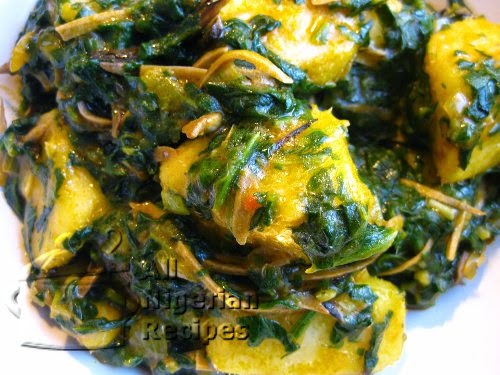
Nigerian Yam & Vegetable with Ukpaka (Ugba)

As the name states, this recipe is a basic yam and vegetable mix. The good thing is that this recipe lets you try a wide range of leafy vegetables which can go with the yam staple: green Amaranth, fluted pumpkin, water leaves, spinach etc.

Ingredients
Yam 1kg Leafy Vegetable - Spinach/Fluted pumpkin/Green Amaranth/Water Leaves Red palm Oil – to colour Okra – 4 fingers (optional) Ukpaka or Ugba: a handful (optional) Onions – 2 medium bulbs Chilli Pepper & Salt – to taste Seasoning: – 2 cubes of Maggi / Knorr
Before you cook Yam & Vegetable
Peel and cut the yam tuber into 2 inch cubes. Wash the yam cubes and place in a sizeable pot. Wash and cut the leafy vegetables, I used frozen spinach. Just leave to defrost a little bit and cut into small pieces. Then when fully defrosted, wring out the excess water. rinse the ukpaka and cut the onions and okra into tiny pieces. Grind / Blend the chilli pepper. Put all these in a separate pot and set aside. The okra only helps the vegetables stick together so it is optional and with the ukpaka, you can go the extra mile with this recipe :) Cooking Directions
Pour enough water to cover the yam cubes and cook till the cubes are soft and the water is a bit like porridge. Now, pour out the water from the pot, leaving the yam cubes in the pot. Cover the pot to retain the heat. Add some water from the yam (about 1 cooking spoon) to the pot containing the vegetables. Cook till the vegetable is softened by the heat. Be careful not to overcook the vegetable. Pour the cooked vegetables and other ingredients into the pot containing the yam cubes. Add the palm oil and salt to taste. Stir with a wooden spoon till all the ingredients have mixed well. The yam and vegetable is ready to be served. Serve on its own or with Fried Plantain
My NairaLand Account
My Blog
My Tumblr Account
My Twitter Account

Friday, 11 April 2014

Cook better with Valerie Kadiri

Valerie Kadiri teaches you how to become a better cook. In this series.

Everyone wants to become better in any skill they
have. Cooking is no exception. Even if you think you
are hopeless in the kitchen; like everything else,
practice and increasing your knowledge makes perfect. Just
relax and pretend that you are playing with the ingredients
and you will realize that cooking is not such a daunting
task. The following are All Nigerian Food Recipes' top 10
tips to becoming a better cook.
1. Add to what you know
Constantly increasing your knowledge of cooking is important because you already
know the basics of cooking and you are interested in improving your skills. Search
for recipes on the web and in cookery books, read them through even if it is a recipe
for a meal you think you have perfected. With Nigerian food recipes, and any other
world recipe, there are often many ways to cook a meal and achieve the same
results. So there's always something new to learn.
When you eat a familiar meal and you notice an improvement in the taste, it is good
to ask the cook what he/she did to achieve that.

My Travel Blog
Idolbin

How to Season and Grill Chicken with Valerie Kadiri

Chicken is used a lot when preparing Nigerian recipes, especially the Rice recipes and stew recipes. Chicken can also be eaten as a snack and washed down with a chilled drink.
You want to season your chicken so that it will be very tasty and you also want to prepare it such that it will be presentable and appetizing. Seasoning chicken is very easy and you only need a few ingredients. Most often, people think that you have to add all the spices and stock cubes in the world to make the chicken tasty. But what all these excess seasoning does to the chicken is to take away the natural flavour of the chicken. To season chicken, you only need these major spices and
ingredients: Chicken - Hen (female chicken) is tougher and tastier than cockerel (male chicken) so when you go to buy chicken, ask your grocer or meat seller for the hen. This is called Gallina in Spanish. You should also buy a whole chicken and cut it up in pieces. Not only is it cheaper but you get the different parts of the chicken which adds to the flavour rather than just one part.
Onions - White, yellow or red onions. Onions are very important when seasoning chicken. Thyme - This is very essential due to the aroma it adds to the chicken. Stock cubes - Maggi or Knorr are the brands that bring out the best taste in Nigerian recipes. Salt - Use salt sparingly when seasoning your chicken. Salt should be added when the chicken is done. Never add salt to raw chicken, see notes below for more information on what adding salt too early does to your chicken or beef. You should also grill your chicken after cooking it rather than deep-fry it. If you have an oven, please grill your chicken because it is healthier. Grilling also makes the chicken taste better.
My Link
My Tumblr Link
NairaLand Link
My Blog

Wednesday, 9 April 2014

Basmati Jollof with Valerie Kadiri

The Nigerian food recipe discussed here is the classic Nigerian Jollof Rice prepared at parties. This is the most popular Nigerian rice recipe. This is why you will always see it in parties. It is quite easy to prepare if you follow the simple steps. How to Cook Nigerian Jollof Rice [Video] The following are other variations of Jollof Rice: Coconut Rice Mixed Vegetable Jollof Rice Rice and Beans Ingredients 2 cigar cups | 500g (1.1 lbs) long grain white rice Tomato Stew 500 mls Chicken (whole chicken, drumsticks or chicken breast) Pepper and salt (to taste) 2 medium onions 3 Knorr cubes 2 teaspoons thyme Before you cook Jollof Rice Prepare the tomato stew. Visit the Tomato Stew page for details on how to do that. It is advisable to prepare tomato stew before hand and keep in the freezer. This is so that whenever you want to cook any jollof rice related dish, it is just a matter of adding it to your cooking. If you will use whole chicken then wash and cut it into pieces. Cook with the thyme, Knorr cubes and 2 bulbs of onions (chopped). The cooking time depends on the type of chicken. The rooster or cockerel cooks much faster than the hen but the hen is definitely tastier. When done, grill it in an oven. You may also fry it. This is to give it a golden look which is more presentable especially if you have guests for dinner. Parboil the rice using the method detailed in parboiling rice for cooking jollof rice. Wash the parboiled rice and put in a sieve to drain. Cooking Directions Pour the chicken stock and the tomato stew into a sizeable pot and leave to boil. Add the drained parboiled rice, salt and pepper to taste. The water level should be the same level of the rice. This is to ensure that all the water dries up by the time the rice is cooked. Cover the pot and leave to cook on low to medium heat. This way the rice does not burn before the water dries up. If you parboiled the rice as described at parboiling rice for cooking jollof rice, the rice should be done by the time the water is dry. Taste to confirm. If not, you will need to add more water and reduce the heat to prevent burning. Keep cooking till done. Serve with fried plantain, Moi Moi, Nigerian salad or coleslaw. You can spice up this recipe by adding 2 well known vegetables to arrive at what we refer to as Mixed Vegetables Jollof Rice. My Tumblr Account My Twitter Account My Blog Page

Tuesday, 8 April 2014

How to make Semolina with Valerie Kadiri

S
Home >> Fufu Recipes >> Semolina Fufu Recipe
How to Make Semolina Fufu
emolina is produced by milling semolina grains into powder. In Nigeria,
Semolina flour is used to prepare the Semolina fufu which is eaten with the
various Nigerian soup recipes . The Semolina fufu recipe is simply prepared by
mixing the semolina flour in hot wate

www​.nairaland.com/ valeriekadiri
valeriekadiri.blog.com/

Cut leafy vegetables faster with Valerie Kadiri

I always say that cooking should be fun not hard labour. Here’s one of the ways to
save some time in the kitchen.
We are taught to arrange leafy vegetables before slicing them. I call that the prim and
proper way where one spends lots of time arranging the vegetables. I don’t even
want to think about arranging and cutting those vegetables on a day I will cook
Nigerian Vegetable Soup (Edikang Ikong).
With the method detailed below, you are done in no time.
Please note that when you want to slice the vegetables for use as garnish for Nkwobi,
Isi Ewu or Abacha, you will need to arrange the vegetables. The good thing is that in
those instances, it’s not too much work because we usually need a small quantity of
vegetables for garnish.
Here’s how to do it:
1. Pick the vegetables from the stalk.
2. Wash them in plenty of cool water. Add salt to the water if you wish.
3. Place the vegetables in a sieve to drain.
4. To slice, deep your finger tips into the vegetables in the sieve and grab as many
leaves as you can comfortably hold in your hand.
5. Place the leaves on a chopping board and cut them in half with a sharp knife.
6. While holding one half of the vegetables in one hand, use your other hand to tuck the
other half under the one you are holding.
7. Using the perfect straight edge of vegetables as reference, slice the rest of the
vegetables normally.
valeriekadiri.blog.com

https://twitter.com/ ValerieKadiri

Cut leafy vegetables faster with Valerie Kadiri

I always say that cooking should be fun not hard labour. Here’s one of the ways to
save some time in the kitchen.
We are taught to arrange leafy vegetables before slicing them. I call that the prim and
proper way where one spends lots of time arranging the vegetables. I don’t even
want to think about arranging and cutting those vegetables on a day I will cook
Nigerian Vegetable Soup (Edikang Ikong).
With the method detailed below, you are done in no time.
Please note that when you want to slice the vegetables for use as garnish for Nkwobi,
Isi Ewu or Abacha, you will need to arrange the vegetables. The good thing is that in
those instances, it’s not too much work because we usually need a small quantity of
vegetables for garnish.
Here’s how to do it:
1. Pick the vegetables from the stalk.
2. Wash them in plenty of cool water. Add salt to the water if you wish.
3. Place the vegetables in a sieve to drain.
4. To slice, deep your finger tips into the vegetables in the sieve and grab as many
leaves as you can comfortably hold in your hand.
5. Place the leaves on a chopping board and cut them in half with a sharp knife.
6. While holding one half of the vegetables in one hand, use your other hand to tuck the
other half under the one you are holding.
7. Using the perfect straight edge of vegetables as reference, slice the rest of the
vegetables normally.
valeriekadiri.blog.com

https://twitter.com/ ValerieKadiri